Enroad - Drive Tracker
- 4.6
- Rating
- 100.00K
- Installs
- Free
- Price

 Analysis by App-foxy
TripRank - Speed Tracker is the kind of auto and vehicle app that turns ordinary driving into something you can look back on, compare, and enjoy. I found its main appeal less in replacing a navigation tool and more in giving each drive a sense of identity. Instead of treating a trip as a route from one place to another, it encourages you to think about the drive itself: how it felt, how it compares with other journeys, and which trips are worth remembering.
That focus makes the app easy to understand. Its store summary, “Flex your drives,” points toward a social and competitive attitude rather than a purely practical one. TripRank is built for people who like cars, road trips, personal driving records, or simply the small satisfaction of seeing one journey stand out from another. In my experience, that narrower purpose is also its greatest strength. It does not need to be everything in the car-app category to be enjoyable.
At the same time, I would not install it expecting a complete replacement for a navigation app, a maintenance log, or a professional fleet system. The best way to approach it is as a companion for tracking and showcasing drives. If that sounds appealing, it has a clear reason to stay on your phone. If you only want directions or fuel-cost calculations, the usual alternatives will probably serve you better.
You May Also Like

 Google Keep - Notes and lists
Google Keep’s Quiet Growth Shows the Appeal of Simpler Notes
As mobile work gets busier, Google Keep keeps winning a simple contest: capture a thought quickly, find it later, and get on with the day.

 Blood Strike: 2.5 Anniversary
Blood Strike’s Loadouts Turn Every Drop Into a Tactical Gamble
A close look at Blood Strike’s custom loadouts: how fast access to signature weapons reshapes its battle royale rhythm, rewards preparation, and narrows the gap between fights.

 Pandora - Music & Podcasts
Pandora’s Music Is Easy to Start, but Harder to Recover
Pandora’s strength is its low-effort path from a seed to a station. Its weak spot is how much confidence it asks you to place in connection, setup, and quiet recovery.

 8 Ball Pool
 Is Built on Rivalries, Rematches, and Routine
A close look at the rivalries, rematches, shared routines, and unanswered safety questions that turn a quick pool match into a persistent mobile community.

 Samsung Music
’s Quiet Strength Is Playing What You Already Own
Its reach comes less from spectacle than from dependable access to a personal library. That simplicity is both the app’s strongest retention engine and its ceiling.

 AccuWeather: Weather Radar
AccuWeather Review: A Quick, Clear Forecast for Everyday Decisions
For everyday plans, the best forecast is the one you can understand quickly. AccuWeather makes rain timing, radar, and local conditions easy to act on, with a few trade-offs.
More From Our News Desk



What makes TripRank enjoyable to use
The central idea behind TripRank is simple: your drives become something you can rank. That changes the emotional role of the app. A normal map application is useful before and during a journey, while this one is more interesting when you want to reflect on the journey afterward. It adds a layer of personal competition and collection to driving without requiring the experience to become complicated.
I especially like the way this concept can work for several kinds of drivers. Someone who enjoys weekend road trips can use it to keep those journeys distinct from everyday errands. A car enthusiast can treat it as a lightweight record of memorable drives. Even a casual driver may enjoy comparing a scenic outing with a routine commute, not because every trip needs to become a contest, but because the comparison gives otherwise forgettable travel a little more character.
The app’s identity is helped by its name. TripRank immediately tells me that the emphasis is on comparing trips, not merely recording a speed reading. That distinction matters. A basic speedometer app answers a single question while you are moving. TripRank aims at the wider story of the drive, which is more engaging for users who want a record they can revisit rather than a number that disappears as soon as the journey ends.
Its free entry point also makes experimentation easy. You can try the core experience without paying upfront, then decide whether the app deserves a regular place in your driving routine. There are optional in-app purchases ranging from around four dollars to nearly sixty dollars per item, so I would recommend checking what each purchase adds before spending. The broad range suggests that not every upgrade will suit every user, particularly someone who only takes occasional drives.
Using it for everyday driving habits
A realistic use case is a driver who has a familiar weekday commute and a longer drive planned for the weekend. The commute may be repetitive, but recording it can create a baseline for comparison. Then, after the weekend journey, the driver has a way to separate that more enjoyable trip from the normal routine. The value is not necessarily in proving that one route is objectively better; it is in making the difference visible inside the app.
I also see a practical use for people who regularly drive several cars. If you alternate between a personal vehicle, a family car, and a work vehicle, TripRank can make the trips feel less interchangeable. That can be useful when deciding which car suits a particular kind of outing. A relaxed local drive, a long open-road journey, and a busy urban trip all have different qualities, and a ranking-focused tool encourages you to notice those differences.
One useful habit is to establish a consistent routine before comparing results. Start or record trips in the same way each time, and avoid judging a short errand against a full-day drive as though they were identical experiences. This is a small but important point: the app can organize your driving memories, but your comparisons will only be meaningful if you give them some context.
Another good approach is to treat rankings as personal rather than absolute. Traffic, weather, passengers, road conditions, and the purpose of a journey all change how a drive feels. A trip that ranks low may still have been valuable, while a high-ranked drive may simply have benefited from ideal circumstances. I found the app more satisfying when I used its comparisons as prompts for reflection instead of treating them as precise judgments about driving quality.
Where it differs from familiar alternatives
Most drivers already have access to a navigation app, and that is where the comparison becomes useful. Navigation tools are designed to help you reach a destination efficiently, often with live route guidance, traffic information, and arrival estimates. TripRank serves a different moment: it gives attention to the drive as an experience. I would use a navigation app to decide how to get somewhere and TripRank to make the journey worth revisiting afterward.
It also differs from a conventional vehicle-maintenance log. A maintenance app is concerned with oil changes, repairs, service intervals, and costs. TripRank is not the tool I would choose for those responsibilities. Its purpose is more personal and recreational, so it makes sense for someone who wants to celebrate drives rather than manage the mechanical side of ownership.
Compared with a dedicated speed tracker, the appeal is broader. A speed-focused tool may be preferable when the only goal is to observe speed-related information while driving. TripRank’s attraction is the ranking concept and the way it frames trips as individual experiences. That makes it more memorable, but it may feel less useful to a driver who wants a single technical instrument and nothing else.
This difference also explains why I would not recommend using any driving app as a reason to drive aggressively. A ranking can be fun, but it should never encourage unsafe behavior, distracted interaction, or attempts to improve a result by ignoring road rules. The sensible workflow is to set things up before moving, leave the phone alone while driving, and review the trip only when parked.
Small details that improve the experience
The first non-obvious advantage is that rankings can help you build a personal archive without requiring every trip to be treated like a major event. If you record only the journeys you genuinely care about, the list becomes more useful over time. I would avoid filling it with every short errand unless you enjoy that level of detail. Selective tracking keeps the memorable drives from getting buried in routine travel.
The second is to use categories in your own mind even if the app presents a single overall ranking. Separate scenic drives, practical journeys, social outings, and ordinary commuting when you interpret the results. A short evening drive may not compete fairly with a long road trip, but it can still be one of your best local drives. This mental sorting makes the app feel more personal and prevents the ranking from becoming unnecessarily rigid.
The third is to use the app as a conversation starter with fellow car enthusiasts rather than as a definitive scorecard. The “Flex your drives” attitude works best when it stays playful. Comparing memorable trips can lead to useful discussions about routes, cars, timing, and driving conditions. It is less enjoyable when users assume that a ranking settles every argument. The app gives you a framework for sharing experiences, not an official measurement of driving ability.
There is also a useful decision-making angle. Before a future outing, you can look at the kinds of trips you enjoyed most and plan around those patterns. Perhaps you prefer relaxed drives over rushed ones, quiet routes over busy roads, or longer journeys with a particular vehicle. TripRank can encourage that kind of self-knowledge, even though the final judgment remains subjective.
The friction I would consider before installing
The biggest limitation is that the app’s value depends on your willingness to care about ranking drives. If you rarely think about past journeys, the concept may feel unnecessary after the initial curiosity fades. The app is not automatically useful simply because it is installed; it needs a habit behind it. Drivers who want an always-on utility may find navigation, fuel, or maintenance tools more consistently practical.
There is also a risk of overinterpreting the results. A ranking can make a trip look more objective than it really is. Without careful context, users may compare unlike journeys and draw conclusions that do not mean much. I would treat the results as a personal record, not as a scientific test of a car, route, or driver.
The optional purchase structure deserves attention as well. The app is free, but some items cost from around four dollars up to nearly sixty dollars. That is a substantial difference between the lowest and highest purchase levels. I would begin with the free experience, identify the feature or upgrade I actually need, and avoid buying simply because a higher tier sounds more complete. For a casual user, the free version may be enough; for a committed enthusiast, a purchase could make more sense if it directly supports a regular workflow.
Another consideration is attention. Any app connected with driving needs disciplined use. I would configure it before leaving, avoid handling the phone on the road, and review rankings once the vehicle is safely parked. This is especially important if the competitive angle makes you eager to check a result immediately. The app should add enjoyment to driving, never become a distraction from it.
Who will get the most from it
TripRank is best for drivers who enjoy turning journeys into personal records. It suits road-trip fans, car enthusiasts, people who like comparing experiences, and users who find motivation in seeing progress or favorites collected in one place. It can also appeal to someone who wants a more playful relationship with driving than a standard map application provides.
I would be more cautious recommending it to a driver who wants detailed vehicle management. If your priority is service history, fuel spending, route planning, or professional driving records, choose a dedicated app built around that job. TripRank’s personality is its advantage, but that personality also means it is not a universal dashboard for every automotive need.
The age rating of Everyone makes it broadly approachable, and the app runs on Android versions from 7.0 onward, which means it is not restricted to only the newest phones. The current release is version 1.6.7, and the developer is 11X Studio. Those details make it easier for owners of older compatible devices to consider, although the actual comfort of use will still depend on the phone and the driving setup.
Its audience size also suggests that the idea has found a receptive group: the app has passed one hundred thousand installs, with an average rating of 4.9 from around eleven thousand ratings. I would view that as encouraging rather than conclusive. High user approval can indicate that the concept works well for its intended audience, but it does not change the basic question of whether you personally want to rank and revisit your drives.
My final view after using the concept in daily life
TripRank - Speed Tracker succeeds because it gives driving a different kind of purpose. It is not trying to be the map, the mechanic, or the instrument panel. Instead, it turns trips into experiences you can compare and remember. I found that approach more appealing than a simple speed display because it gives the app a reason to be opened after the car is parked, when reflection and sharing are safer and more enjoyable.
The recommendation is therefore quite specific. Install it if you like road trips, car culture, personal challenges, or the idea of building a collection of drives that matter to you. Start with a few meaningful journeys, compare similar trips fairly, and keep the rankings playful. That workflow gives the app its best chance of becoming a lasting habit rather than a novelty.
Skip it if you need navigation, maintenance management, or a strictly technical driving instrument. Those jobs call for more specialized alternatives. For everyone else, the free download makes it easy to test the idea without commitment, while the optional purchases should be approached selectively. My verdict is positive but focused: this is a charming companion for people who want to flex their drives, not a replacement for every other automotive app.
FAQs for Enroad - Drive Tracker
01What is TripRank - Speed Tracker, and how does it work?
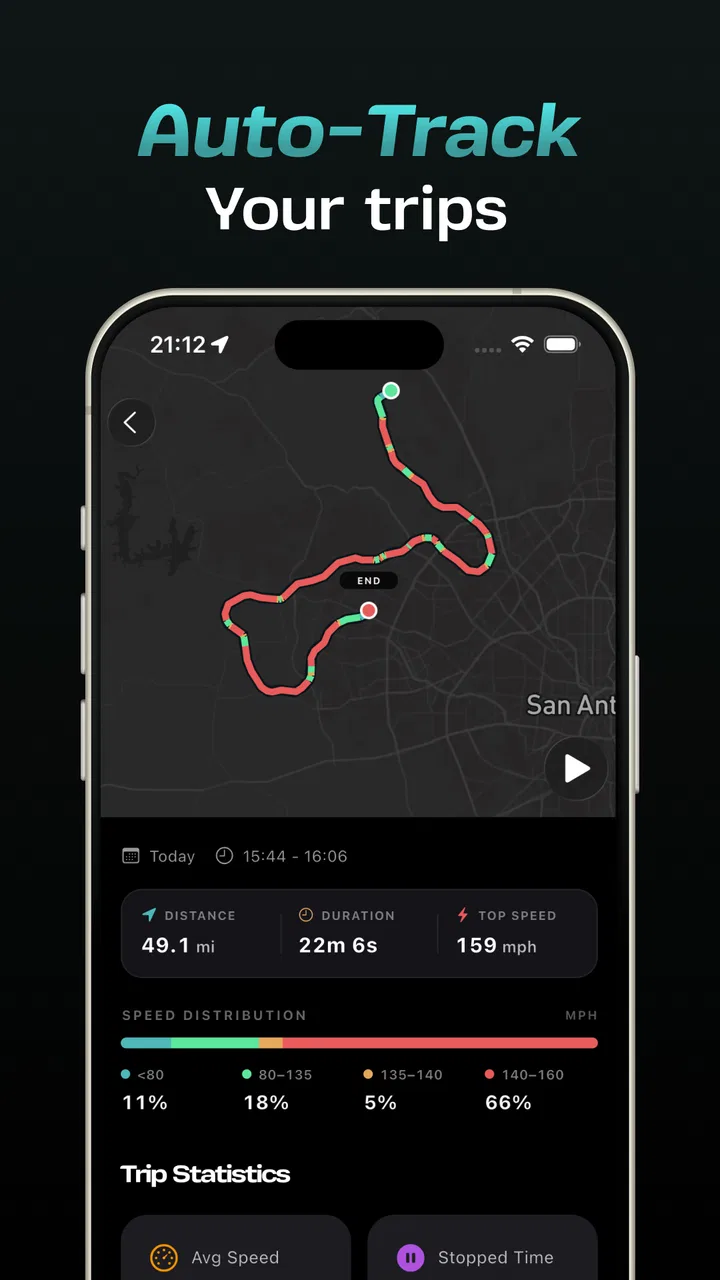
TripRank - Speed Tracker is a mobile application designed to monitor and analyze your travel speed in real-time. It uses your device's GPS to track movement, providing detailed reports on speed, distance, and travel time. This can help users ensure they're adhering to speed limits and improve travel efficiency.
02Is TripRank - Speed Tracker compatible with both Android and iOS devices?
Yes, TripRank - Speed Tracker is available for both Android and iOS platforms. You can download it from the Google Play Store or Apple App Store. Ensure your device meets the minimum operating system requirements for optimal performance and functionality.
03Does TripRank - Speed Tracker consume a lot of battery power?
TripRank - Speed Tracker utilizes GPS technology, which can lead to increased battery consumption. However, the app includes power-saving features and settings adjustments to minimize battery drain. It's recommended to use a car charger if you plan to use the app for extended periods.
04Is my data safe with TripRank - Speed Tracker?
TripRank - Speed Tracker prioritizes user privacy and data security. The app collects only the necessary data to provide its services and adheres to strict privacy policies. Users can review and manage their data settings within the app to ensure their information is secure.
05Can TripRank - Speed Tracker be used for cycling or walking?
Yes, TripRank - Speed Tracker can track various forms of movement, including cycling and walking. The app adjusts its tracking capabilities to suit different activities, providing accurate speed and distance data regardless of your mode of travel. Choose the appropriate activity mode to get tailored insights.
Pros
- Intuitive interface for easy navigation.
- Accurate tracking of speed and distance.
- Customizable alerts for speed limits.
- Comprehensive trip history logs.
- Works offline for remote areas.
Cons
- Consumes battery quickly during use.
- Limited features in free version.
- Occasional GPS signal loss.
- Ads can be intrusive at times.
- Requires constant background location access.

Enroad - Drive Tracker
Gallery